Boston and its Story 1630 - 1915 by Edward M. Hartwell Edward W. McGlenen
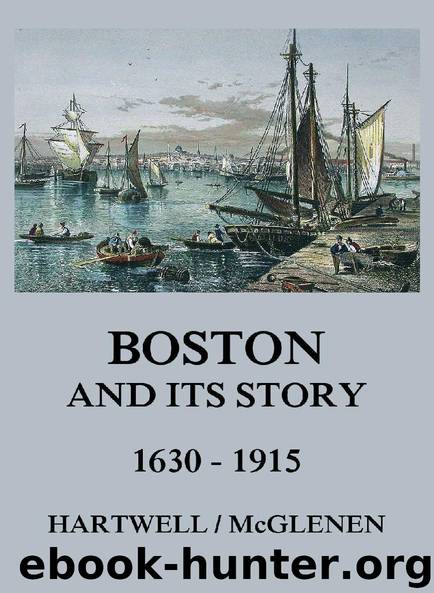
Author:Edward M. Hartwell, Edward W. McGlenen [Edward M. Hartwell, Edward W. McGlenen]
Language: eng
Format: epub
Tags: Geschichte
Publisher: Jazzybee Verlag
Published: 2018-01-24T23:00:00+00:00
II.
Under the stimulus of opportunity, their commercial instincts were speedily aroused. Accordingly, the trade of Boston grew both in volume and variety from the first, by reason of the enterprise shown in developing coastwise traffic in fish and furs, corn and tobacco. Thus, in May, 1631, there arrived in Boston a pinnace from Virginia laden with corn and tobacco, and in 1634 a single vessel brought 10,000 bushels of corn from thence. Winthrop's bark, the Blessing of the Bay, launched in 1631, traded with the Dutch at Manhattan, and with Saint Kitts, one of the West India Islands, as well as with English settlements in New Hampshire and Maine. Winthrop makes frequent mention of the arrival at Boston, in coastwise craft, of passengers bound for England. In 1633 a small ship of sixty tons was built at Medford. This craft, "The Rebecca," in 1634 brought 500 bushels of corn from Narragansett, and in March, 1636, arrived from Bermuda "with 30,000 weight of potatoes, and store of oranges and limes." The number of craft engaged in this early coastwise trade cannot be stated, but in 1635 the number of English ships trading to New England was put at more than "forty sail," of which "six at least" were said to belong in New England.
In the period 1640-60, which was signalized by the Civil War, the emergence and downfall of the Puritan Commonwealth in England, the Puritan Commonwealth in the Bay continued to prosper. In 1643 the Long Parliament showed its favor by formally granting it free trade. This measure seems to have stimulated industrial enterprise in and about Boston. Massachusetts fishermen began to extend their operations to the Banks of Newfoundland. Exportation of masts to England, which began as early as 1634, attained large proportions. Shipbuilding began in Boston in 1642, where a rope-walk had been started in 1641. By 1719 there were fourteen shipyards in Boston, and by 1741 it sustained an equal number of rope-walks.
It was officially set forth by the Lords of Trade, in 1721, respecting the Province of Massachusetts, that the people had "all sorts of common manufactures, but that the branch of trade that was of most importance to them, and which they were best enabled to carry on was the building of ships, sloops, etc." About 150 vessels were built in a year, measuring 6,000 tons, mostly for sale abroad, while there were about 190 sail owned in the Province, besides 150 boats employed in the coast fisheries.
In 1736 there were 43 vessels on the stocks at one time in Boston, and 41 in 1738. In 1749 the number of such vessels had declined to 15. But the decline of shipbuilding at Boston in this period is attributable in some measure to its increase in other towns of Massachusetts, e. g., Gloucester and Haverhill. It is said that in the period 1769-71, "more than one half of the American tonnage, or from 10,000 to 12,000 tons, were built in Massachusetts and New Hampshire.
By 1642 the
Download
This site does not store any files on its server. We only index and link to content provided by other sites. Please contact the content providers to delete copyright contents if any and email us, we'll remove relevant links or contents immediately.
| Africa | Americas |
| Arctic & Antarctica | Asia |
| Australia & Oceania | Europe |
| Middle East | Russia |
| United States | World |
| Ancient Civilizations | Military |
| Historical Study & Educational Resources |
Cat's cradle by Kurt Vonnegut(15355)
Pimp by Iceberg Slim(14507)
4 3 2 1: A Novel by Paul Auster(12392)
Underground: A Human History of the Worlds Beneath Our Feet by Will Hunt(12098)
The Radium Girls by Kate Moore(12028)
Wiseguy by Nicholas Pileggi(5786)
The Fire Next Time by James Baldwin(5446)
Perfect Rhythm by Jae(5403)
American History Stories, Volume III (Yesterday's Classics) by Pratt Mara L(5307)
Paper Towns by Green John(5191)
Pale Blue Dot by Carl Sagan(5008)
A Higher Loyalty: Truth, Lies, and Leadership by James Comey(4964)
The Mayflower and the Pilgrims' New World by Nathaniel Philbrick(4503)
The Doomsday Machine by Daniel Ellsberg(4490)
Killers of the Flower Moon: The Osage Murders and the Birth of the FBI by David Grann(4447)
The Sympathizer by Viet Thanh Nguyen(4390)
Too Much and Not the Mood by Durga Chew-Bose(4348)
The Borden Murders by Sarah Miller(4325)
Sticky Fingers by Joe Hagan(4198)
